I recently heard Jefferson Fisher speak, and I walked away with lots of notes—not the “wow, that was inspiring” kind that sit in a notebook forever, but the kind that quietly follow you into real conversations. The ones that tap you on the shoulder later and say, Hey… remember this?
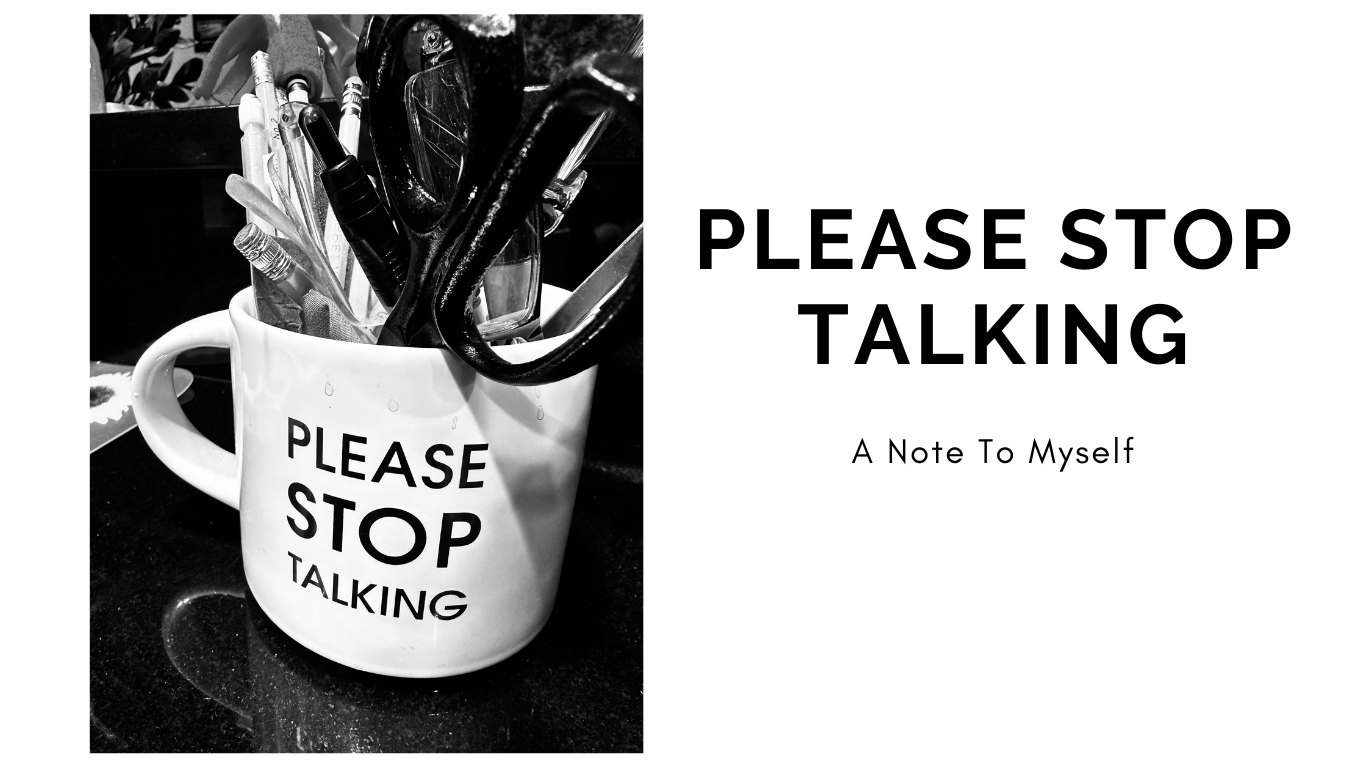
When Alex was about 12 years old, we were out somewhere and I had been talking to (ok, possibly lecturing) him about something. We were browsing a gift shop and Alex spotted a mug that said: “Please stop talking.”
I laughed.
Then I paused.
Then I thought…
Oh. This might be feedback.
And honestly? He wasn’t wrong.
Before the Conversation Even Starts
One of Jefferson’s strongest points was this: good conversations don’t start when you open your mouth—they start when you prepare.
Before walking into something important, he suggested writing down three things:
- What’s the goal? Not “to win” or “to be right,” but something reasonable—I want to understand where they’re coming from.
- What’s your reason? Why does this matter to you? If you can’t articulate that, the conversation will wander.
- What’s your ask? What do you actually need from the other person?
That framework alone would have saved me from many overly long, circular conversations with Alex that ended with… well… a mug suggestion.
Have Something to Learn, Not Something to Prove
This one landed hard.
Jefferson talked about how often we enter conversations with a position to defend instead of curiosity to explore. We set out to win. To be right. To make our point airtight.
But conversations unravel more cleanly when you approach them with something to learn rather than something to prove.
That means being open to changing your mind.
It means untangling the knot instead of pulling it tighter.
It means asking questions like:
“Did you mean for that to embarrass me?”
“Did you mean that to come across as dismissive?”
Not as accusations—but as invitations to clarify.
“The best conversations don’t start with what you want to say—they start with what you’re willing to learn.” -Jefferson Fisher
Slow Is Strong
Another reminder I needed: walk, don’t run, when triaging a situation.
Let your breath be the first word. If you really need to say something, try:
“Let me think about that.”
“I need a second.”
Consider Their Feelings
Second their feelings before responding. This is definitely I need to work on! His suggestions were so simple but effective.
“I can see why that was frustrating.”
“I agree—it’s a difficult time.”
Slowing things down isn’t weakness. It’s control.
Road-Mapping the Conversation
One of my favorite practical tools was what Jefferson called road-mapping—setting expectations upfront to avoid extended, exhausting conversations.
Things like:
- “I’m telling you this because I know you value transparency.”
- “You need to know this immediately.”
- “I trust you to handle this.”
It frames the conversation before it drifts.
And then, ask yourself:
- What’s the one thing I need to walk away with?
- What do I want to talk about?
- How do I want to feel afterward?
- What do I want the other person to walk away with?
Sometimes the most powerful response really is:
“Noted.”
“Got it.”
(Yes, mug… I hear you.)
Your Body Is Talking Too
Communication isn’t just words.
Jefferson reminded us, when talking with someone:
- Keep your shoulders back
- Make eye contact (not in a creepy way)—finish the sentence looking at the person
- Keer your hands visible—it shows you’ve nothing to hide (Now this one I don’t have a problem with. My hands are often in motion when speaking.)
Confidence shows up before your voice does. And the more vulnerable you’re willing to be, the safer the conversation becomes.
Level It
One final phrase that stuck with me: “Level it.”
His suggestions to help the other person feel seen.
“I agree this is hard.”
“I can see this matters.”
“I’m with you.”
Unity changes the temperature of a room.
So About the Mug…
The mug now sits on my desk—not as a joke (okay, partly a joke), but as a reminder.
Not every silence needs to be filled.
Not every thought needs to be voiced.
And sometimes the most effective thing you can say is… nothing at all.
Or at least:
“Let me think about that.”
A Gentle Invitation
The next time you head into a conversation that matters—at work, at home, or somewhere in between—pause for just a moment.
- Write down your goal.
- Decide what you’re willing to learn.
- Take a breath before you speak.
And if it helps, keep a quiet reminder nearby—maybe even on a mug—that says what we all occasionally need to hear: Please stop talking.
Because sometimes, choosing to listen is the change.
Want to have better conversations?
Check out Jefferson Fisher at Jefferson Fisher | Improve Your Conversations